
While I was visiting my husband’s family, my mother in law received a bag of tasty looking fruit. One day at lunch time she was getting ready to cut some up for the kids, and we were discussing our favorite varieties of apples. She is fond of the Gala and Jonathan, while my family is usually happiest with the Granny Smiths. Neither of us particularly care for the red delicious as they are generally not very crisp, but we were certainly not prepared for what we found when she cut into that first apple….
It was completely rotten at the core.
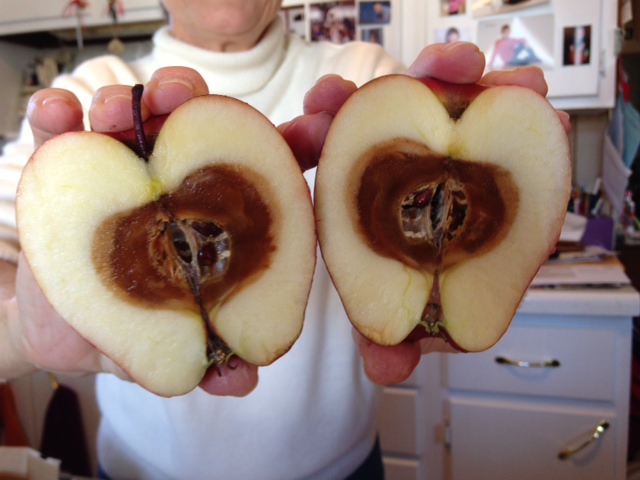
Usually when fruit is beaten or bruised or broken on the outside, we steer clear of it. But this apple looked nice and shiny and red with no soft spots or discoloration. There were no outward signs of what lurked beneath.
People can be a lot like that, too. We clean up pretty well, don’t we? Put on some make up to accentuate our best facial features, dress in our most flattering outfit, style our hair just so and exhibit good behavior to make a good impression on others and appear desirable. But what about our insides? All too often we neglect what can’t be seen with the human eye. Paul gave Peter some advice to pass on to the women of his church in 1 Peter 3:3-4 when he wrote, “Do not let your adornment be merely outward – arranging the hair, wearing gold, or putting on fine apparel – rather let it be the hidden person of the heart, with the incorruptible beauty of a gentle and quiet spirit, which is very precious in the sight of God.” This is not to say that there is anything inherently wrong about dressing nicely or being well groomed, but that what is most valuable to God is found beneath the surface.
Making assumptions about people based on their appearance is not a new situation. Saul was the first king chosen by the Israelites because of his pleasing outward appearance. He was a strong, tall, handsome war hero and they thought he would make the perfect ruler. Until that point, God had served as the King of the Jews, but the Israelites saw that the other nations around them had earthly rulers and they wanted one for themselves. Unfortunately, Saul turned out to be disobedient to God, jealous, feeble and eventually went crazy.
Even before Saul’s demise, God sent the prophet Samuel on a mission to anoint his successor. The search took Him to the town of Bethlehem, to a man named Jesse and his sons. Samuel looked at the oldest son and thought he was the one, however God told Samuel, “Do not look at his appearance or at his physical stature, because I have refused him.” 1 Samuel 16:7. In fact, God did not prompt Samuel to select any of the seven oldest sons. Instead, he asked to see the youngest, David, who was called in from where he was tending the sheep. “For the Lord does not see as man sees, for man looks at the outward appearance, but the Lord looks at the heart.” 1 Samuel 16:7. God had chosen David as the one who would rule after Saul because He knew what was in his heart. Luke relates God’s own endorsement of David in Acts 13:22, “He raised up for them David as a king, to whom also He gave testimony and said, “I have found David, the son of Jesse, a man after My own heart, who will do all my will.’” David was a wise ruler and faithfully sought the will of God in his life.
To say David was a man after God’s own heart does not mean that he was free from sin. On the contrary, his failures are well documented. David did, however, understand that God was the author of everything good in his life and that his sin must be dealt with.
He “said unto the Lord, ‘You are my Lord; apart from you I have no good thing.’” Psalm 16:2 (NLT). To acknowledge that anything virtuous, respectable, righteous, honorable, truthful or worthy in us comes from God is an act of humility. Proverbs 3:34 says that “God resists the proud, but gives grace to the humble.” I would rather acknowledge by own unworthiness and receive the grace and forgiveness of God than continue on in my sin under the impression that I know more than God or can be good apart from Him. God is good and I am not. He is holy and I am not. But when I confess my transgressions and accept His grace, He sees the righteousness of His Son when He looks at me.
David also realized that trying to cover up his rottenness to make himself look good to others only led to more sin. David had an affair with the wife of one of his Soldiers who was away at war. When Bathsheba became pregnant, David was desperate to cover up his transgression and devised a plot to have the Soldier stranded and left for dead during battle. David’s first sin of lust and coveting another man’s wife led to adultery, lies and ultimately to murder. That seems like a headline ripped from our news today! Maybe times haven’t changed as much as we might like to think. Chances are your sins haven’t led you quite so far down this slippery slope of depravity, but this should fill you with a sense of hope that no matter what the sin, every sinner can still be considered to be a person after God’s own heart. No matter what kind of rottenness lurks beneath your skin, God has the power to make you fresh and new.
Some of the most beautiful and passionate psalms contain the confessions of David and the joy he felt when his relationship with God was restored.
Wash me thoroughly from my iniquity,
And cleanse me from my sin.
For I acknowledge my transgression,
And my sin is always before me.
Against You, only You, have I sinned,
And done this evil in Your sight –
Behold, You desire truth in the inward parts,
And in the hidden part You will make me to know wisdom.
Hide Your face from my sins,
And blot out all my iniquities.
Create in me a clean heart, O God,
And renew a steadfast spirit within me.
Do not cast me away from Your presence,
And do not take Your Holy Spirit from me.
Restore to me the joy of Your salvation,
And uphold me by Your generous Spirit.
Then I will teach transgressors Your ways,
And sinners shall be converted to You.
Psalm 51-2-3, 6, 9-13
Perhaps this is a lesson David passed on to his son Solomon who included it in his own wise sayings, “He who covers his sin will not prosper, but whoever confesses and forsakes them will have mercy.” Proverbs 28:13
There are plenty of ways we try to make ourselves look appealing from the outside, like a nice shiny apple but only one way to be desirable to God on the inside. Jesus recognized this dilemma among the religious leaders when he told them, “So you outwardly appear righteous to others, but within you are full of hypocrisy and lawlessness.” Matthew 23:28. They tried very hard to appear righteous before men by adhering to their own interpretations of the law and condemning all those who failed, but it was the beaten, the bruised and the broken that the Son of God chose to spend His time with. He called the Pharisees and scribes hypocrites, and called the dishonest tax collectors, the doubtful, the unloved, the outcasts, the sinners and even the one who would betray Him to be part of His inner circle, to be His disciples. He chose to spend time in the company of people who knew they were rotten apples, because He knew that by having a relationship with Him, they could be saved, forgiven, made clean from the inside out.
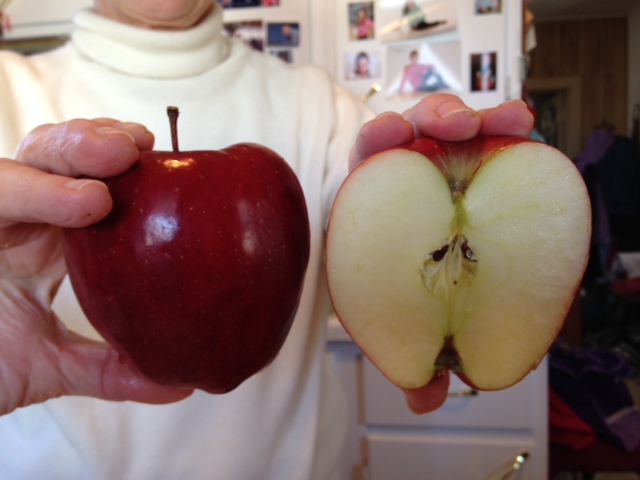
The condition of our hearts is known to us and God alone. It is fairly easy to convince others of our goodness. Sometimes, we are even capable of deceiving ourselves, but never Him. Eventually, the rottenness on the inside of that apple would have eaten away at all of the flesh and shown through the skin. Left untended and unconfessed, the results of our sin will eventually manifest themselves outwardly, too.
My mother in law was forced to toss that rotten apple, because it wasn’t fit to eat. Once our rottenness is exposed, we prove that we aren’t good for anything either. There is nothing we can do about our core on our own though. We are no more capable of purifying our own hearts than the apple is of changing its rot to crisp, healthy fruit. The apple is a lost cause, but you and I are not. Jesus alone can cure the decay and rottenness inherent in each of us, and we’ve all got some. “If we confess our sins, He is faithful and just to forgive us our sins and to cleanse us from all unrighteousness.” 1 John 1:9
Would you rather be surprised that an ugly-skinned apple has sweet, delicious, healthy fruit inside or be disappointed by a pretty looking fruit that is decayed inside?
Let’s not worry so much with our outward appearance, but rather place the focus on the inside. Let’s give God the chance to restore and cleanse us so that we might be pleasing to Him. Let’s learn to select friends, leaders, co-workers, or recipients of our goodwill based not on their outward appearance, but more for the condition and potential of their hearts. Let’s share with others the love and grace of our heavenly Father who has the power to make us new from the inside out!


“Create in me a clean heart, O God, and renew a right spirit within me.”
Another good one, Liz! I’m a rotten apple, but it’s comforting to know God still loves me.